
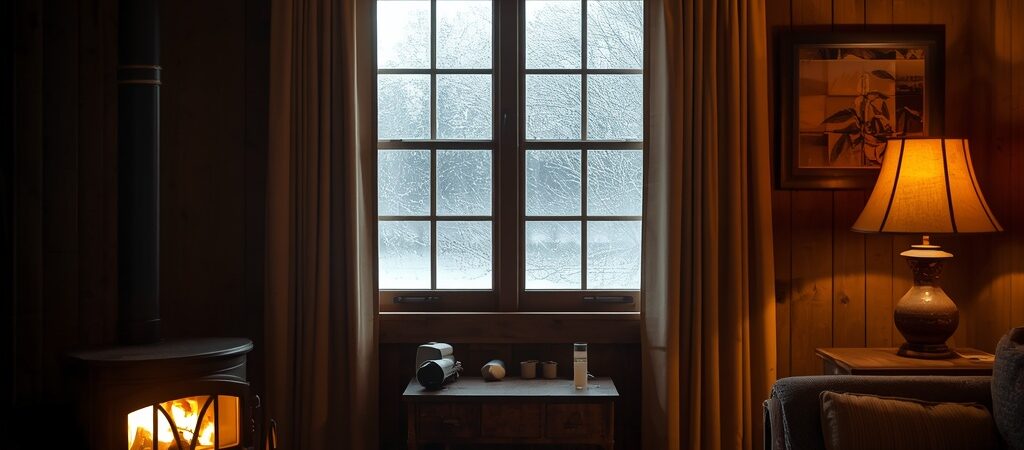
If the power went out for a week this winter, would your house stay warm? For Amish households across Lancaster County, Holmes County, and Elkhart-LaGrange, that’s not a hypothetical — it’s simply how the house has always been heated. None of these methods are exotic or expensive to try, and most can be added to a home that already has electric heat as a backup rather than a replacement.
Masonry heaters and heat retention
A traditional masonry heater — sometimes called a Russian or Finnish stove — burns a hot, fast fire for an hour or two, then radiates that heat slowly for the next twelve to twenty-four hours as the brick or soapstone mass releases it. It’s a completely different approach than a modern wood stove, which needs almost constant small fires to keep a steady temperature. The trade-off is patience and an upfront masonry investment, in exchange for far less wood burned overall and a much more even heat.
Wood stoves sized to the room, not the house
Many Amish homes don’t try to heat every room evenly. A single well-placed wood stove heats the kitchen and main living space, doors stay closed on bedrooms during the day, and quilts do the rest at night. It sounds like a sacrifice until you notice how much energy modern homes waste heating rooms nobody is sitting in.
Rocket mass heaters for outbuildings
For a workshop, greenhouse, or detached kitchen, a rocket mass heater burns a small amount of wood extremely efficiently, then routes the exhaust through a bench or bed of thermal mass before it ever reaches the chimney. Some designs get useful heat from wood scraps that would otherwise be kindling. It’s a bigger build project than a stove, but the fuel savings are real.
Sun-facing windows and thermal mass, used on purpose
South-facing windows aren’t decoration — they’re a heating strategy. A row of windows facing the sun, paired with something dense inside to hold that heat (stone, water barrels, even a brick floor), keeps a room measurably warmer through the afternoon and into the evening without burning anything at all. It costs nothing but orientation and timing.
Insulation the old-fashioned way
Before spray foam, homes were insulated with straw bales, wool batting, and thick plaster walls — and many still are. None of it is as convenient as a modern insulation crew, but straw bale construction in particular has R-values that rival or beat conventional framing, at a fraction of the material cost, using something a working farm already produces.
Heavy curtains and a closed-door philosophy
This one costs almost nothing: heavy curtains over every window, closed at dusk, and doors kept shut between heated and unheated spaces. It sounds too simple to matter, but a single-pane window loses heat fast, and a thick curtain can cut that loss dramatically for the price of fabric.
Livestock as a heat source
A barn full of animals generates real, measurable heat — enough that many older farmhouses were built with the barn attached or close by on purpose, so the animals’ body heat took the worst of the winter chill off the house’s coldest wall. It’s not a strategy that works for everyone, but it’s a reminder that heat doesn’t only come from a fire.
None of these require going fully off-grid to start using. Heavy curtains this week, a properly sized wood stove next year, a masonry heater when the budget allows — each one stacks on the last, and each one is one less thing the power company controls.
If you want a running list of the specific stoves, curtains, and insulation supplies that make this practical, I keep a shoppable Energy Savings list on Amazon updated with what I’d actually buy.